2026
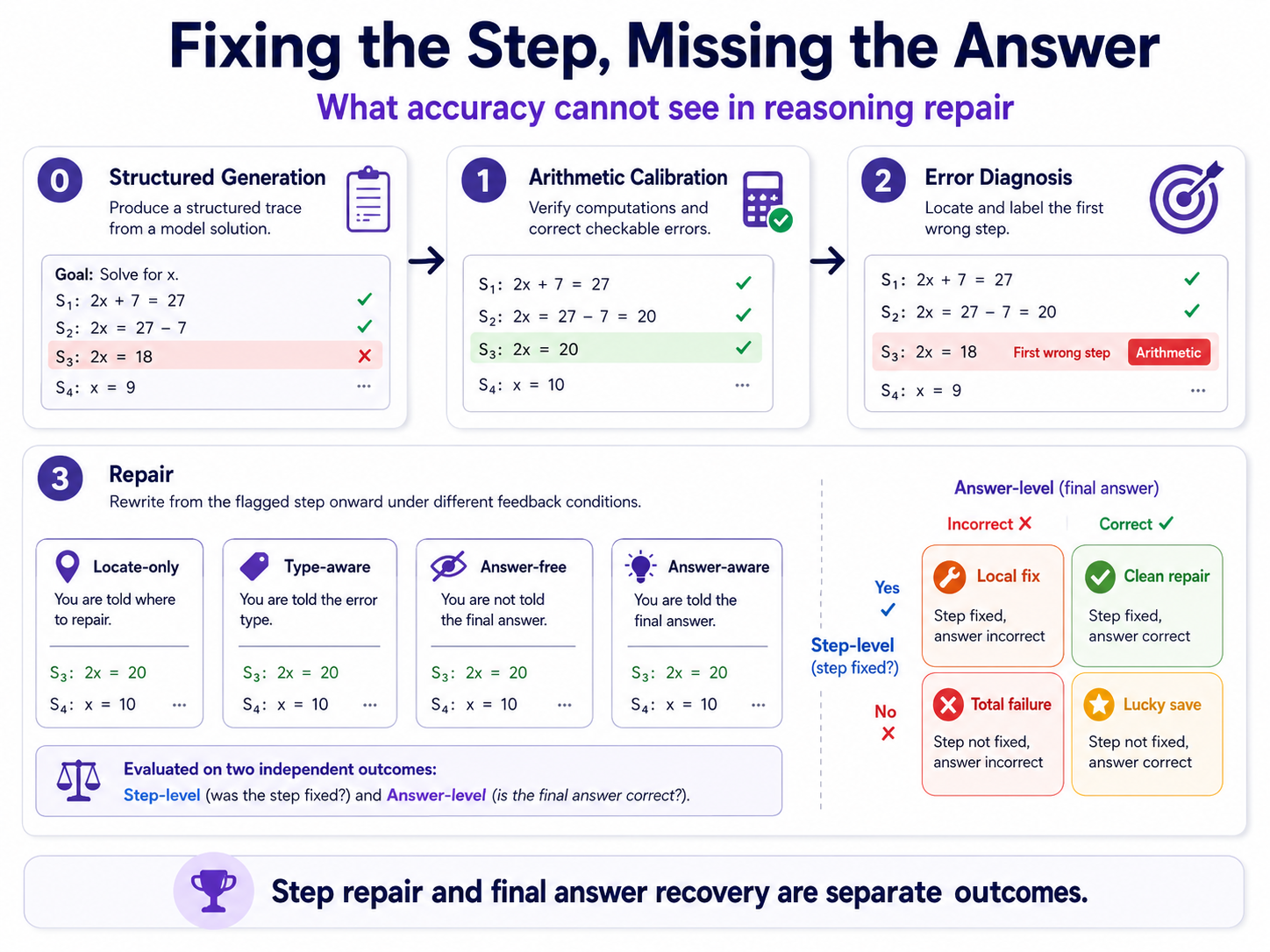
Fixing the Step, Missing the Answer: What Accuracy Cannot See in Reasoning Repair
COLM 2026 Workshop on Efficient Reasoning
I am an AI researcher with an M.S. in Computer Science from Northeastern University. At Northeastern, I conducted research with the Generative AI Research Group and served as a teaching assistant for Machine Learning. Before my master's study, I also worked in industry on artificial intelligence and computer vision. That experience gave me the chance to work across both academic research and real world AI systems, and it continues to shape the kinds of questions I care about.
My research focuses on how AI systems understand information, reason, make decisions, and fail, as well as how those capabilities can be evaluated more reliably. I am especially interested in LLM reasoning and mathematical reasoning. Rather than judging a model only by its final answer, I want to understand what happens throughout the reasoning process. This includes the capabilities required at different stages, where errors emerge, how they influence later steps, and whether correcting a local failure truly improves the overall reasoning outcome.
I also have a long standing interest in computer vision, video understanding, vision language models, and multimodal AI. My earlier industry work was centered on visual systems, so I remain interested in how models move from perception to higher level understanding and action. This includes object and action recognition, temporal video understanding, visual grounding, vision language reasoning, and multimodal decision making. I am particularly interested in systems that must connect what they see with context, language, and downstream decisions, and in evaluating whether those decisions are actually supported by the available visual evidence.
More broadly, I care about trustworthy AI, model reliability, data and evaluation, and efficient AI systems. My long term goal is to better understand what capabilities AI systems genuinely acquire, how and why they fail, and how that understanding can help build systems that are more reliable, verifiable, and meaningful in practice.
My current work centers on reasoning, evaluation, and reliability. I am interested in understanding what capabilities models actually possess, how those capabilities interact inside longer tasks, and why behavior that appears reliable in one setting may break in another. Mathematical reasoning offers a controlled setting for studying these questions across different stages of problem solving. Vision and multimodal systems extend the same perspective to perception, grounding, contextual understanding, and evidence based decisions.
Reasoning quality cannot always be captured by the final answer. A correct result may contain weak intermediate reasoning, while fixing one incorrect step does not necessarily recover the rest of the solution. My work examines where reasoning errors begin, how they affect later steps, and what happens after an intermediate failure is corrected.
This motivates process level evaluation that separates the quality of individual steps from the consistency of the full reasoning process and the final outcome. It also raises questions about verification, error propagation, and recovery after a failure has already influenced later steps. The goal is to understand what a model can actually do rather than treating answer accuracy as a complete measure of reasoning ability.
Mathematical problem solving depends on several capabilities that are often compressed into one accuracy number. Problem understanding, formulation, planning, action selection, computation, verification, revision, and recovery can each succeed or fail in different ways.
I want to understand how these components interact and which capabilities a model genuinely possesses. Computation is one current focus, especially when a capability that works in a simple setting becomes unreliable inside a longer reasoning context.
The same framework can later extend to planning, action selection, formulation, verification, and other parts of the reasoning process. The larger question is how these abilities combine into a stable problem solving system rather than appearing only as isolated strengths.
Reliable evaluation depends on more than the model being tested. Data quality, labeling decisions, supporting evidence, human review, and metric design can all change the conclusions we draw about model capability. I am interested in evaluation that preserves enough information to inspect why a prediction was considered correct, where disagreements come from, and which failure patterns are hidden by aggregate scores. My goal is to make these factors easier to inspect and audit, so that evaluation reflects what a model can actually do rather than what a benchmark happens to reward.
My interest in vision comes from both research and production systems. I care about how models recognize objects and actions, understand temporal structure in video, and connect visual evidence with language, context, and downstream decisions. In multimodal settings, a strong answer is not enough if the model cannot be traced back to the image regions, events, or relationships that support that answer.
I am interested in separating failures in perception, temporal understanding, grounding, and higher level reasoning. This includes questions around video understanding, vision language models, visual grounding, multimodal evaluation, and how language changes the interpretation of visual evidence. I also care about the practical side of these systems, including data quality, model adaptation, efficient inference, and deployment constraints when visual models must operate reliably outside a benchmark.
Additional computation is useful only when it changes the quality of the reasoning process. More tokens or more internal computation do not automatically mean that a model is reasoning better. I am interested in when a model should continue, verify an intermediate result, revise an earlier decision, allocate more internal computation, or stop. The central question is whether extra computation produces a meaningful change in capability rather than only increasing cost.


I was born in Taiwan and grew up in Suzhou, where I spent my childhood and most of my school years. In 2024, I moved to Seattle for graduate school. After living in several different cities, I gradually became interested in something in particular, how people slowly build their everyday lives in a new environment.
Whenever I arrive somewhere new, I usually do not rush to check off tourist attractions. Instead of heading straight for the landmarks, I prefer to take my time, wander through the streets, notice the small differences between neighborhoods, and experience the people, architecture, and everyday life from different perspectives.
Trying local food is also an important part of that. I like everything from street food and small local favorites to restaurants worth making a special trip for and Michelin-starred restaurants, so I also really enjoy "摘星星" (collecting Michelin stars). After enough walking and eating, a personal map of the city slowly starts to form in my head. That is probably my favorite way to get to know a new place.
Travel and photography are probably the two things most capable of pulling me away from work for a while. I enjoy photographing streets, landscapes, architecture, and ordinary moments that are easy to miss if you move too quickly. I also have a habit I have never quite managed to fix. What starts as a short walk somehow always turns into a much longer one, because there always seems to be one more street worth exploring, and I always feel that the next photo might be better. I keep reminding myself to spend less time in front of a screen and more time seeing the world, but somehow I fail every time. Maybe next time... XDD.
I probably am a bit of a workaholic. When I come across something that genuinely makes me curious, I can easily keep digging until I get to the bottom of it. Something that starts as just checking one small thing can turn into several hours before I even realize it. That is why I am often still online late at night. I am definitely a night owl, so if you message me in the middle of the night, there is a pretty good chance I am still around and very much awake. People around me have asked more than once whether I actually sleep. Of course I do... probably? My schedule just has its own ideas. Sometimes I even fall asleep and continue thinking about my research in my dreams. People also like to joke that I work too hard and call me "卷王" (someone who is always pushing harder and doing more). But for me, time does not wait. There are still many things I want to do and many questions I want to understand, so while I still have the energy and curiosity, I would rather go a little further and do a little more.
Family and the people close to me have always been very important to me. No matter how busy life gets, I try to make time for the people I care about, whether that means talking, having a meal together, or simply sharing small things from everyday life. The older I get, the more I feel that the memories that stay with us are not only the loudest or most dramatic moments, but also the ordinary days spent with family and friends. Many of those days feel completely normal while we are living them. Only later, when we look back, do we realize how special they actually were. Maybe something does not have to be grand to become precious. Sorry, that suddenly got a little too serious XDD.