2026
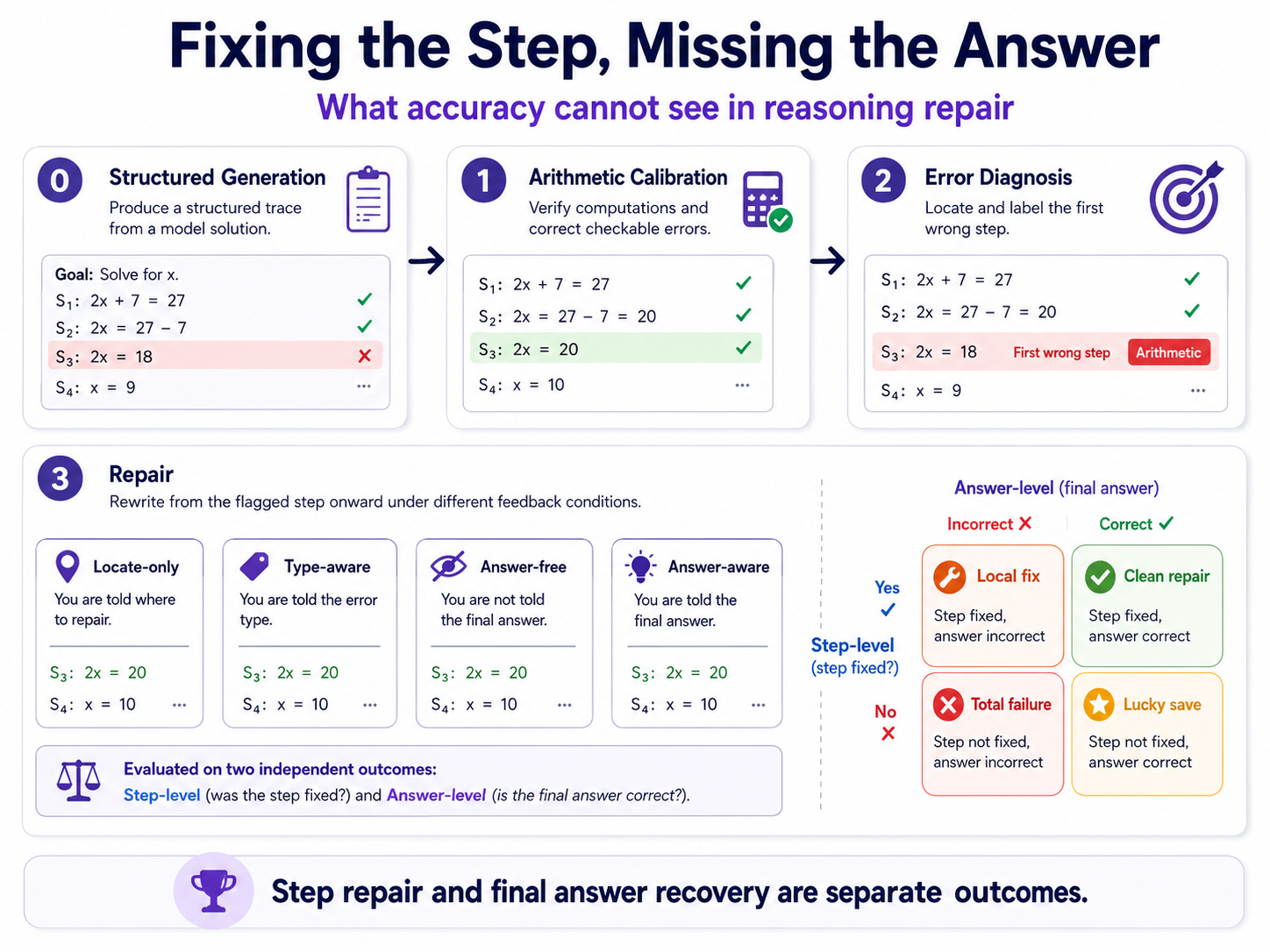
Fixing the Step, Missing the Answer: What Accuracy Cannot See in Reasoning Repair
COLM 2026 Workshop on Efficient Reasoning
I am an AI researcher with an M.S. in Computer Science from Northeastern University. At Northeastern, I conducted research with the Generative AI Research Group and served as a teaching assistant for Machine Learning. Before my master's study, I also worked in industry on artificial intelligence and computer vision. That experience gave me the chance to work across both academic research and real world AI systems, and it continues to shape the kinds of questions I care about.
My research focuses on how AI systems understand information, reason, make decisions, and fail, as well as how those capabilities can be evaluated more reliably. I am especially interested in LLM reasoning and mathematical reasoning. Rather than judging a model only by its final answer, I want to understand what happens throughout the reasoning process. This includes the capabilities required at different stages, where errors emerge, how they influence later steps, and whether correcting a local failure truly improves the overall reasoning outcome.
I also have a long standing interest in computer vision, video understanding, vision language models, and multimodal AI. I am interested in how models connect perception with higher level understanding and reasoning, how their decisions are grounded in visual and contextual evidence, and how reliability can be studied across different modalities.
More broadly, I care about trustworthy AI, model reliability, data and evaluation, and efficient AI systems. My long term goal is to better understand what capabilities AI systems genuinely acquire, how and why they fail, and how that understanding can help build systems that are more reliable, verifiable, and meaningful in practice.
I am currently open to full time opportunities in AI research and engineering. I am particularly interested in teams where careful experimentation, model understanding, and practical system building are valued. If my background aligns with your work, I would be glad to connect.
My current work centers on reasoning, evaluation, and reliability. I am interested in understanding what capabilities models actually possess, how those capabilities interact inside longer tasks, and why behavior that appears reliable in one setting may break in another. Mathematical reasoning offers a controlled setting for studying these questions across different stages of problem solving. Vision and multimodal systems extend the same perspective to perception, grounding, contextual understanding, and evidence based decisions.
Reasoning quality cannot always be captured by the final answer. A correct result may contain weak intermediate reasoning, while fixing one incorrect step does not necessarily recover the rest of the solution. My work examines where reasoning errors begin, how they affect later steps, and what happens after an intermediate failure is corrected.
This motivates process level evaluation that separates the quality of individual steps from the consistency of the full reasoning process and the final outcome. It also raises questions about verification, error propagation, and recovery after a failure has already influenced later steps. The goal is to understand what a model can actually do rather than treating answer accuracy as a complete measure of reasoning ability.
Mathematical problem solving depends on several capabilities that are often compressed into one accuracy number. Problem understanding, formulation, planning, action selection, computation, verification, revision, and recovery can each succeed or fail in different ways.
I want to understand how these components interact and which capabilities a model genuinely possesses. Computation is one current focus, especially when a capability that works in a simple setting becomes unreliable inside a longer reasoning context.
The same framework can later extend to planning, action selection, formulation, verification, and other parts of the reasoning process. The larger question is how these abilities combine into a stable problem solving system rather than appearing only as isolated strengths.
Reliable evaluation depends on more than the model being tested. Data quality, labeling decisions, supporting evidence, human review, and metric design can all change the conclusions we draw about model capability. I am interested in evaluation that preserves enough information to inspect why a prediction was considered correct, where disagreements come from, and which failure patterns are hidden by aggregate scores. My goal is to make these factors easier to inspect and audit, so that evaluation reflects what a model can actually do rather than what a benchmark happens to reward.
Multimodal systems should do more than combine image and language features. Their conclusions should be supported by the visual evidence, temporal context, actions, objects, and semantic relationships that are actually present in the input.
I am interested in separating failures in perception, grounding, contextual understanding, and reasoning, and in studying how language changes the way visual evidence is interpreted. This creates a way to connect questions from language model reliability with image and video understanding while keeping the model's use of evidence visible.
Additional computation is useful only when it changes the quality of the reasoning process. More tokens or more internal computation do not automatically mean that a model is reasoning better. I am interested in when a model should continue, verify an intermediate result, revise an earlier decision, allocate more internal computation, or stop. The central question is whether extra computation produces a meaningful change in capability rather than only increasing cost.


I was born in Taiwan and grew up in Suzhou, where I spent much of my childhood and student years. In 2024, I moved to Seattle for graduate school. Living in different cities and environments has made me comfortable adapting to new places, meeting people with different backgrounds, and experiencing different ways of life.
Outside research, I enjoy traveling and photography. I like exploring cities on foot, trying local food, and capturing streets, landscapes, architecture, and everyday moments through my camera. After spending much of the past few years focused on research and technical work, I have also been trying to step away from the screen more often and experience more of the world around me.
Family and close relationships are very important to me. No matter how busy things become, I try to make time to talk, share meals, and stay connected with my family and friends. When I have a quiet evening at home, I also occasionally play Counter Strike to relax.